The Rise of Automated Job Search: Can AI Really Apply for You?

For decades, job hunting was a struggle of patience, persistence, and lots of manual effort. But as we move further into the 2020s, technology has quietly but powerfully begun to rewrite this story. Today, automation and AI technologies are not just industry buzzwords; they’re practical helpers transforming how millions approach the job search. Let’s explore what automated job search really means and how it’s shifting the landscape for job seekers everywhere.
What Is Automated Job Search?
Think back a decade or so, and job hunting meant a test of patience and persistence: days combing through endless listings, copy-pasting the same credentials, and waiting for replies that rarely came. Fast forward to 2025 and the story is being rewritten by technology—especially the kind that quietly works behind the scenes. Automated AI job search is no longer a buzzword, but a rapidly growing reality for professionals at every stage.
At its heart, an automated job search uses smart technologies—mostly driven by artificial intelligence—to tackle the most tedious parts of finding work. Instead of manually sifting through postings or tweaking a resume for every single opening, these AI tools handle the grunt work. They can scan job boards, suggest opportunities, and, for certain platforms, even handle applications while the candidate is off living life. For people balancing busy schedules, family, or even multiple gigs, this shift can feel like gaining an entire support staff overnight.
How AI Applies to Job Boards
Major job boards today bear little resemblance to their earlier forms. Old-fashioned sites offered laundry lists of open roles, but today’s AI-powered boards actively recommend positions based on a person’s skills, location, and work history. These platforms are getting better at understanding what candidates really want. Some even read between the lines—learning that someone who’s posted about working remotely probably doesn’t want in-person roles or that a sales manager eyeing courses in data analytics might be exploring a career change.
What’s more, integrations between new AI tools and established job sites make it possible for a seeker to upload a resume, set preferences, and let software take over the search and apply process. AI not only flags highly relevant jobs but can parse subtle hints in job descriptions, exposing less obvious matches and surfacing leads that recruiters often keep under the radar. The result? Less wasted time and, for many, better alignment with both career and lifestyle goals.
The Difference Between Job Alerts and AI Auto-Apply
Job alerts have been around for years—“Set it and forget it” email updates that drop new postings based on keywords. But as working with AI matures, job seekers are realizing the difference between a daily alert and a platform that can truly apply on their behalf. AI auto-apply doesn’t just notify—it actively engages: auto-filling application forms, attaching the right documents, and tweaking the language to echo a company’s tone.
Brian VanderWaal, an industry consultant who’s tracked the job search market for over a decade, puts it plainly: “AI is no longer a megaphone shouting opportunity—it's a quiet assistant, learning your style and making introductions before you even know you need them”.
Why Job Seekers Are Turning to AI Tools
Job hunting is rarely anyone's favorite pastime—and with good reason. Think of the time spent tweaking your resume, filling out countless application forms, keeping track of where you applied, and hoping for responses. For many, the process can feel like running in place, burning energy with little immediate reward. That’s where AI-powered job search tools come into play, offering candidates a better, more efficient way to handle the quest.
These tools act like your behind-the-scenes assistant. Instead of submitting just a few applications each week, people using AI can send out many more—all customized, targeted, and carefully tailored to fit what companies really want. For example, LiftmyCV has built a system that not only helps create resumes perfectly aligned with job descriptions but can send applications across popular sites like LinkedIn, Greenhouse, and Wellfound. This means job seekers don’t have to waste valuable time on repetitive tasks but can instead focus on prepping for interviews or expanding their network.
Another big win with AI is how it improves resume matching. Rather than just peppering in keywords, advanced AI reviews the requirements, spots what’s missing or undersold in a profile, and even suggests better ways to highlight relevant experience. It’s like having a career coach who’s done hours of homework on the company, so you don’t have to. That’s why many recruiters say the best resumes today “speak the language” of ATS (Applicant Tracking Systems) while still appealing to human readers.
And let’s be honest—applying for jobs can be exhausting, especially when dozens or hundreds of applications are expected in today’s markets. AI tools ease that burden by tracking applications, reminding candidates when to follow up, and even intelligently autofilling forms. The result? More applications without burning out.
Candidates who’ve embraced these technologies often report higher callback rates—sometimes jumping from a handful of responses to nearly half their applications. It’s no surprise why AI job search tools have become a must-have for anyone serious about landing their next position.
Comparison Table: Manual vs. AI-Enhanced Job Search
|
Aspect |
Traditional Method |
AI-Enhanced Approach |
|
Number of Applications per Hour |
2-3 |
10-25 |
|
Chances to Pass ATS |
Moderate |
Much Higher |
|
Customization Quality |
Depends on effort |
Data-backed and consistent |
|
Risk of Burnout |
High |
Significantly Lower |
|
Time Spent Per Week |
Several Hours |
Under an Hour |
The Benefits of Automated Job Search
Looking for a job isn’t just about sending out resumes; it can feel like a juggling act with a million moving parts. I remember how time-consuming and frustrating it was before AI-powered tools like LiftmyCV came into the picture.
Honestly, using LiftmyCV felt like handing off my job search grunt work to a pro assistant. The platform helped me tailor my resumes to the specific jobs I wanted, and it applied to multiple platforms — LinkedIn, Wellfound, even niche boards I didn’t have time to check. What used to take me days, sometimes weeks, happened within hours—and my callbacks actually went up.
Why Speed Matters
If you’ve been hunting for jobs, you know opportunities can disappear fast. Employers often look at early applicants first, so speed is a competitive advantage. AI tools give you that edge by automating repetitive tasks so you can submit more applications without the exhaustion.
One recruiter I spoke to said, “Candidates who use automation often get noticed faster because their applications are well-crafted and timely.” That resonated with me—I wanted quality and speed.
Beating Applicant Tracking Systems
I used to worry my resume was getting swallowed by a black hole—applicant tracking systems that filter out most submissions before a person even reads them.
What surprised me was how AI tools can optimize resumes smartly, focusing on context and phrasing, to pass these filters while still sounding natural to human readers. It felt like having a coach whispering winning strategies in my ear.
Casting a Larger Net
Before automation, I was mostly applying on LinkedIn and a couple of big job boards. But the AI tools showed me there’s a whole ecosystem of platforms, niche sites, and company portals that fly under most people’s radar. By reaching more places with smartly tailored applications, I found opportunities I never knew existed—some in exciting industries I hadn’t considered before.
Comparison Table: Why Automation Works
Benefit |
What It Means for You |
|
Submit More, Faster |
More tailored applications in less time |
|
Smarter Resume Optimization |
Better chances of beating automated resume filters |
|
Reach More Job Platforms |
Job listings beyond the usual sites |
|
Reduce Errors and Overlap |
Automation minimizes mistakes and missed deadlines |
|
More Time to Prepare Interviews |
Spend your energy where it counts—interviewing and networking |
The Risks and Limitations of Automated Job Search
Look, AI job search tools sound like the dream—fast, efficient, effortless. But at the risk of sounding like Debbie Downer, it's worth remembering these aren’t magic bullets. They come with their own quirks, risks, and yes, a few deal breakers you should know before diving in headfirst.
So, is automated job search safe?
That’s the question I hear most. When you hand over your personal data—your work history, contact info, maybe even bank details—trust becomes huge. Employers want legit applications; you want your identity and info locked down tight. So, who’s accountable if something goes sideways? Spoiler: It’s a grey area, and not every platform has ironclad security.
According to a recent McKinsey survey, more than half of employees in 2025 are worried about cybersecurity around AI. Right behind that, concerns swirl about whether the data AI tools handle is accurate and private. My advice? Do your homework. Pick tools with solid security practices, transparency, and strong privacy policies. Your information deserves top-shelf protection.
Can employers spot AI applications?
Here’s where it gets interesting. Recruiters are getting smarter by the day, some using AI themselves to sniff out robotic or generic applications. If your submission feels like a clone—cookie-cutter and soulless—it’ll likely hit the “no” pile fast.
That’s why your secret sauce matters. Use AI to streamline, yes, but sprinkle in personal touches. Mention specific projects, show enthusiasm for the company’s mission, and let your human side shine. Trust me, that human polish makes all the difference.
Why human personalization still matters
AI can churn out a hundred applications, but it can’t grasp the subtle things—a cultural fit, a well-told story, or that spark that catches a recruiter’s eye. The best applications come from candidates who blend automation with genuine personality.
A recruiter once confided, “Tech skills are great, but if your application sounds like an algorithm wrote it, it’s missing soul.” That stuck with me. Use AI to do the heavy lifting—but your authentic voice? Keep that front and center.
Why LiftmyCV is a Must-Have for Job Seekers in 2025
Anyone who’s been through the grind of job hunting knows how frustrating it can get—hours lost scrolling job boards, endless forms, and tailoring resumes over and over. This is exactly where LiftmyCV steps in as more than just a tool: it’s like a personal assistant who never sleeps.
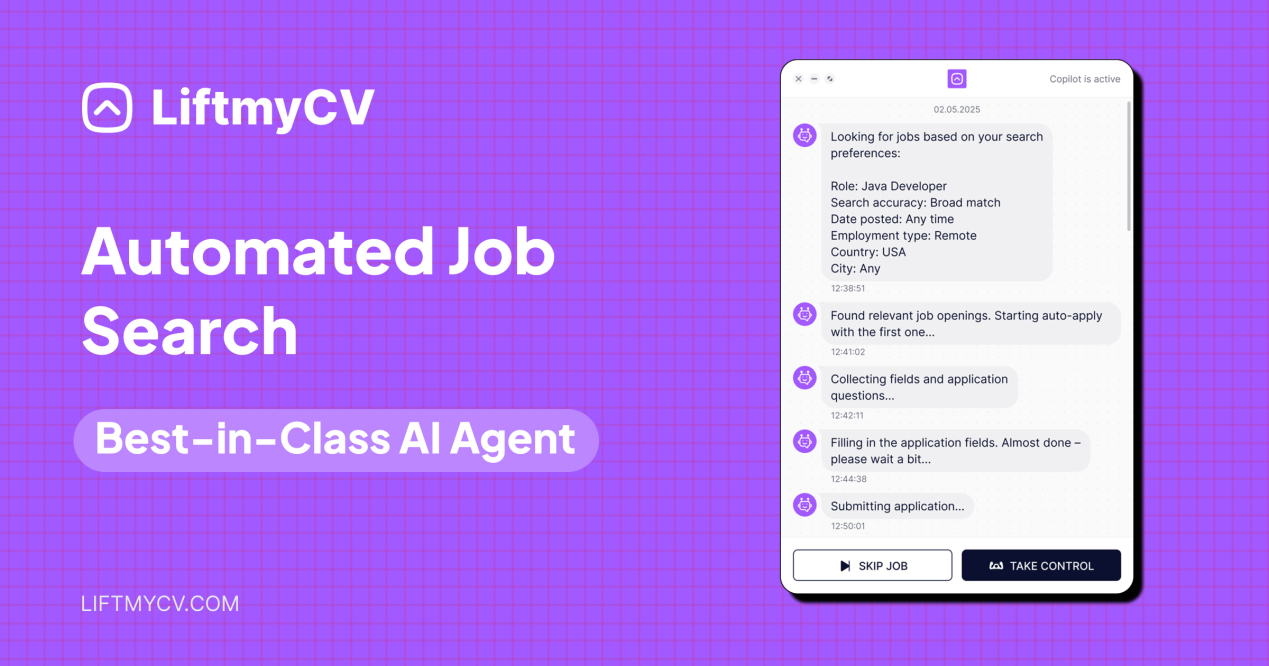
Powered by advanced AI including ChatGPT, LiftmyCV scans dozens of top job platforms such as LinkedIn, Monster, Greenhouse, Wellfound, and Glassdoor. But the magic is in its auto-apply feature, which does all the tedious work for you. It creates customized, ATS-friendly resumes and uniquely tailored cover letters for each job, boosting your chances of passing automated screenings while still appealing to real recruiters.
One cool thing I like: LiftmyCV lets you choose between autopilot and copilot modes.
In autopilot, the AI handles everything automatically and continuously applies to relevant jobs. But if you want control, copilot lets you review each application, tweak the details, and decide what goes out.
Tracking your progress is often overlooked but vital—and LiftmyCV shines here. Its Chrome extension keeps all your applications, replies, and interview invites in one neat dashboard. You get real-time updates, so you’re never left guessing what happened after you hit send.
Pricing? LiftmyCV offers flexible payment options designed to fit every job seeker's needs, giving you full control over your spending.
You can choose between a monthly subscription plan or a pay-as-you-go model, and even combine both to maximize flexibility. This approach means you aren't locked into expensive subscriptions if you prefer to manage your application volume month-to-month.
- The monthly subscription provides a set number of guaranteed applications per month plus premium support, ideal for those who want convenience and predictability.
- The pay-as-you-go model lets you purchase credits (called "Lifts") which you use only when you apply, ensuring you only pay for the applications you actually send.
Additionally, LiftmyCV includes a free trial plan so you can test the service thoroughly before committing—no credit card required.
In 2025, users consistently report more interview callbacks after switching to platforms like LiftmyCV. It’s clear this blend of smart AI job search automation and user control is changing the game for job seekers everywhere.
What’s Next for AI in Your Job Hunt?
If you think the AI revolution in job searching is winding down, think again. It’s still just getting started, and honestly, the best is yet to come.
Imagine AI that doesn’t just match keywords but really gets you—the kind that understands what kind of work environment you thrive in, what values you care about, even how you gel with certain corporate cultures. That’s where things are headed. The “matchmaker” AI won’t just connect resumes to jobs, but people to places where they can grow.
And interviews? Forget dull practice sessions. Picture slipping on a VR headset and practicing your interview skills with an AI coach that gives real-time feedback on your tone, body language, and answers. Sounds sci-fi? Not for long.
There’s no doubt security and privacy will be front and center as AI digs deeper into your career life. People want to trust these systems, and handling personal data carefully won’t be optional.
But here’s the thing: no matter how smart AI gets, it won’t ever replace the spark of human connection and storytelling that wins jobs. The key will be smart partnerships between people and machines—letting AI handle the grunt work while you do what you do best.
In the end, it’s not about AI replacing you—it’s about AI making you better at your own unique story.
